Some decisions matter long after the certification runs out. Picking the ideal CPR course sits high on that Helpful site list. The distinctions in between an AED course, a Basic Life Support credential, and a standard CPR course shape exactly how with confidence you can act when seconds count. I have shown first aid and CPR training to workplace teams, child care workers, and hospital staff, and I have actually seen just how the ideal suit in between training course and learner changes actions under stress and anxiety. The labels can appear compatible from a distance, yet each program has a details purpose, deepness, and audience.
This overview breaks down the functional differences, aids you select a path that fits your duty, and flags the tiny information that determine whether a certification in fact satisfies a workplace or licensing need. Along the road, I will share what has a tendency to trip people up on assessment day, what aids skills stick for more than a week, and how to make the most of a cpr correspondence course without duplicating the very same drills on autopilot.
What CPR training actually aims to do
Cardiopulmonary resuscitation exists to purchase time. When the heart stops or hardly presses, oxygen delivery to the brain and body organs drops to near no. Every min without effective compressions trims survival by approximately 7 to 10 percent, though spectator CPR can halve that decline. Training courses that concentrate on CPR teach just how to identify heart attack, begin chest compressions with the ideal deepness and rate, add breaths if shown, and rotate rescuers prior to fatigue ruins quality.
An AED, the automated outside defibrillator seen in airport terminals and fitness centers, targets a part of heart attacks triggered by shockable rhythms such as ventricular fibrillation. Early defibrillation can bring back organized rhythm within the first couple of mins. AED accessibility and proper usage increase the impact of CPR. BLS, the Basic Life Support credential used in healthcare, layers in sophisticated synergy, air passage abilities, and multi‑rescuer coordination, after that tests at a typical implied for specialists who perform resuscitation extra often.
The 3 names on the menu
A fast positioning helps:
- Standard CPR: Teaches acknowledgment, compressions, and optional rescue breaths for adults, or grownups and kids if you choose the incorporated version. A common suitable for work environments, fitness teachers, and neighborhood members. CPR with AED: Criterion CPR skills plus hands‑on AED release. In numerous regions this is bundled immediately, since AEDs are currently extensive in public venues. BLS (Fundamental Life Assistance): For health care setups and scientific trainees. Covers CPR and AED utilize with extra emphasis on two‑rescuer cycles, bag‑mask air flow, choking relief throughout ages, and in‑hospital rhythms of response.
That is the picture. The real distinctions receive program content, screening, and recognition by regulators or employers.
What you learn in a basic CPR course
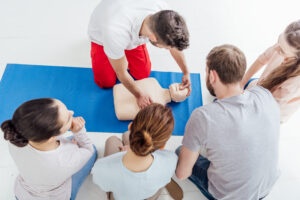
A conventional cpr course, sometimes identified "Heartsaver" or "Grown-up CPR," focuses on adult physiology and one of the most common scenes a non‑clinician will encounter: a coworker who breaks down, a parent who all of a sudden comes to be unresponsive at dinner, a passerby plunged on the path. You will exercise threat checks, responsiveness checks, calling emergency services, hands‑only compressions, and, if the curriculum includes it, air flows with a pocket first aid courses in gladstone mask. In incorporated first aid and cpr courses, you additionally learn bleeding control, burns, cracks, and clinical emergencies like stroke and diabetic issues.
Expect trainers to sign you on compression high quality more than anything else. Real‑time manikin responses is common currently, and it matters. A pupil might think their compressions are deep enough, but the manikin's sensor exposes a 30 percent shortage. That gap clarifies bad end results in real life. A great course drills rhythm, deepness, and recoil till your hands discover the mark without conscious effort.
From the management side, a conventional CPR certification typically notes the range: Adult CPR, Grownup and Kid CPR, or Grownup, Child, and Baby. If your task involves children, such as early youth education and learning, check that the card specifies Child and Baby. I have actually seen child care employees repeat training since their previous certification only claimed Adult.
Where an AED gets in the photo: nearly everywhere. Lots of training companies now pack AED in conventional CPR because AEDs are becoming global in shopping centers, institutions, and business schools. If the card needs to say "CPR and AED," validate that the course consists of AED drills with pads positioning, shock advisory triggers, and safety and security checks.
What AED‑specific training adds
Standalone AED training is lean. You learn where to discover AEDs, exactly how to open the situation, power it on, and follow its triggers. You practice pad positioning on grown-up and, if called for, pediatric manikins. You rehearse clearing the individual before shock and returning to compressions instantly after. Some classes cover grandfather clauses: damp settings, hairy chests, implanted gadgets, and medicine patches.
Where it fits: companies that currently educate CPR may require a brief AED add‑on for teams responsible for their structure's tool. I have instructed compressed AED orientations throughout security days where staff turn via terminals. Even 10 focused minutes can protect against freeze‑ups. You do not desire somebody peeling the support off both pads at once or sticking them together mid‑panic.
A crucial nuance: AED training does not change CPR. Without compressions, defibrillation has much less to work with. If you only have time or budget for one skill, select CPR with AED as a bundle. That combination is the backbone of the majority of modern-day first aid course frameworks aimed at the public.
What sets BLS apart
BLS looks acquainted initially look, yet the requirements move higher and the context changes to team action. Two‑rescuer adult CPR cycles, bag‑mask air flow technique, pulse checks, and switching roles without letting compressions drift off target are all main. Choking relief for grownups, kids, and infants obtains even more detail and technique. The AED series is treated as muscular tissue memory, not an add‑on.

You will be examined a lot more purely in BLS than in a common course, often with timed situations and manikin comments limits. Medical care employees require a repeatable ability level that stands in a code blue or an ambulance bay. A professional trainee who gets to positioning with a community CPR certificate might be turned away from the ward till they hold a BLS card, because the medical facility's plan and insurer expect that credential.
Where BLS really makes its keep is team choreography. In the field, I have enjoyed an experienced BLS set struck a tidy tempo: one rescuer handles the respiratory tract with a bag‑mask seal and supplies breaths at the correct rate while the various other maintains compressions limited and swaps out every two mins at the rhythm check. Oxygen flows, exhaustion remains low, and perfusion remains solid. That tempo is difficult to find out in a purely solo‑rescuer course.
Recognizing severe edge cases
Experienced instructors will certainly reveal you the edge information that make a distinction during uncommon however consequential scenarios.
- DNR orders and progressed instructions: In some setups an arm band or documents will certainly disallow resuscitation. In public, you may not have that clearness. Training courses need to cover when to begin, when to quit, and just how to hand over to arriving paramedics. Traumatic arrest: Penetrating trauma or major candid pressure might require quick hemorrhage control together with compressions. Criterion CPR courses might just touch this lightly. First aid training that consists of bleeding control with tourniquets and hemostatic gauze fills up that gap. Pregnancy: Left uterine variation throughout compressions can boost venous return. A BLS program may address this. Neighborhood programs might not. Opioid overdose: Recognition of respiratory system arrest with a pulse changes your immediate actions. Some first aid and cpr courses currently incorporate naloxone training. Ask if that issues in your area. Hypothermia and drowning: Rewarming and mild handling affect outcomes, and you may expand resuscitation efforts longer. Not every class explores this depth, however it deserves increasing if your setting makes it relevant.
How to choose the best path
Your duty, atmosphere, and compliance requires drive the choice greater than personal passion. A functional method to determine:
- If you are a nurse, paramedic student, oral aide, or anyone who works in a professional setup, pick BLS. Lots of health centers call for a specific releasing body too, so verify that information with your instructor or supervisor prior to booking. If you take care of a fitness center, work in aged treatment assistance without professional duties, show team courses, or supervise groups in a public location, publication a CPR with AED program. If your location offers households, consist of Kid and Baby modules. If you are a moms and dad or caregiver looking for baseline competence, a basic first aid and cpr course that includes AED is the most well balanced. It offers you CPR skills, AED self-confidence, and injury feedback beyond heart issues.
Certificates ought to match the language on your task description or regulative requirement. I have seen people renovate training due to the fact that their "Workplace First Aid" card did not state "Offer cardiopulmonary resuscitation," despite the fact that they had actually covered it in class. Excellent service providers such as First Aid Pro and similar organizations plainly note systems of competency and range on the certification. Read that fine print prior to you pay.
What a first aid course covers beyond CPR
CPR might be the headline, however the rest of first aid can be the difference in between a bad day and a disastrous one. Bleeding control, consisting of direct pressure and tourniquet usage, takes mins to discover and can save a life on a roadside. Burns treatment, eye injuries, bronchial asthma activity plans, anaphylaxis response with an auto‑injector, and stroke acknowledgment round out a capable responder's toolkit. Numerous employers now require a combined first aid and cpr course to meet duty‑of‑care obligations.
In class, scenarios that mix clinical problems with CPR drive home just how fast top priorities change. An asthmatic teenager falls down after physical effort. Do you reach for a spacer or start compressions? The answer depends upon responsiveness and breathing evaluation, taught early in a great program. People who have only exercised neat, separated abilities typically stall when confronted with an untidy scene. Situation variety in training prevents that.
AED usefulness individuals forget
Even brief AED training can eliminate rubbing later, however retention discolors. I ask groups to locate the closest gadget, open the cabinet, and pull the system out, also if we are not in an official cpr training session. That small act solutions the device's area in memory and reveals any type of gain access to problems. Marketing posters in some cases direct the wrong way after a renovation. The number of websites where the AED cabinet is obstructed by a delivery cart or a short-term indication would certainly surprise you.
Pads expire, batteries diminish, and pediatric pads go missing out on. The monthly devices check need to consist of the AED standing light, pad expiry day, and a glance at the accessory set: razor, pocket mask, handwear covers, and a clean. Throughout a genuine event, you will be happy for a pre‑packed kit that represents sweat, breast hair, or a medication patch that requires removal. I have actually seen a well‑intentioned -responder fight with pads on a damp swimmer because no towel was nearby. Add a small towel to your AED cabinet if your site has water exposure.
The skill that matters most in every course
Quality compressions make the most significant difference. Rate, deepness, chest recoil, and minimal interruptions form the core. The trouble is not knowing this, it is doing it for numerous mins without drift. Tiredness creeps in around the ninety‑second mark, in some cases quicker. In BLS, revolving rescuers every two mins protects top quality. In a basic cpr course for solo responders, teachers ought to still push you to feel your very own fatigue curve and change position, hand placement, and breathing to remain effective.
I trainer trainees to treat the first thirty secs as a warm‑up to settle their rhythm. Lock joints, stack shoulders over hands, allow your hips bring some of the activity, and maintain your eyes on the sternum. Do not jump. Utilize the manikin's comments if readily available, then shut your eyes for a couple of compressions and attempt to feel the exact same deepness and recoil. When you open them, see just how close your interior sense was. That proprioception rollovers under anxiety when you lack an electronic prompt.
How long your certificate lasts, and why refresher courses matter
Most CPR and BLS certificates bring a one‑year suggestion for refresher courses. First aid certifications frequently last three years, with CPR rejuvenated each year. That is not an arbitrary profits play. Abilities degeneration rapidly. By 3 to 6 months, also trained suppliers wander on compression depth and price. A cpr correspondence course resets technique and updates you on standard modifications. It also maintains you comfy with an AED if you rarely touch one.
Pick refreshers that do not really feel like reruns. Ask your service provider exactly how they vary circumstances. A white-collar worker does not require a trauma‑heavy drill whenever, but a new spin, such as a confined‑space reaction or a two‑rescuer sequence with an AED showing up late, helps you adjust. Shorter, focused refreshers work well for groups that exercise quarterly in bite‑sized sessions rather than cramming everything into a yearly marathon.
Accreditation, placement, and the great print
Not all training courses are developed equal, also if the leaflets look similar. In lots of nations, companies and regulators recognize certifications from particular bodies or need positioning with nationwide resuscitation guidelines. If your role has lawful commitments, confirm the supplier's accreditation and the specific device codes affixed to the first aid certificate. Medical facilities commonly specify they require BLS from assigned companies. Childcare regulations might specify first aid and cpr course content consisting of asthma and anaphylaxis modules.
Watch for covert risks:
- Online only CPR without hands‑on assessment might not fulfill office requirements. Blended knowing, which sets e‑learning with a short sensible session, usually pleases both benefit and compliance. Infant CPR is not always included. If you look after babies, make certain the training course provides infant components and that you exercise on baby manikins. Remote or high‑risk worksites might require extra coverage such as oxygen treatment training or advanced bleeding control. A common neighborhood course will not cover these.
Reputable providers, including names like First Aid Pro and various other recognized organizations, will map their courses to acknowledged standards and release those details. If you can not discover them, ask.
Making skills stick after the class
Training days construct confidence, but behaviors keep you all set. The very best first aid training plants little regimens that last.
I motivate individuals to do 2 things: practice a psychological script and touch the equipment. The script does not need to be made complex. Identify, call, compress, shock, continue. State it out loud periodically. For teams, appoint functions ahead of time. Who fetches the AED? That satisfies the rescue at the lift? In one office, a receptionist kept a brilliant lanyard identified "AED jogger" on a hook near the front desk. During a drill, there was no argument, she grabbed it and relocated. That sort of quality reduces the wasted secs that sit between a collapse and the very first compression.
As for devices, treat your AED and first aid set like a fire extinguisher. Individuals only utilize them in a dilemma, so they must really feel familiar. Open up the package every quarter. Examine the pocket mask, gloves, and a few vital items. Put your hands on the AED, keep in mind the expiry day on the pads, and listen for the gadget's self‑test beep. A thirty‑second routine keeps items from coming to be strangers.

Comparing the program types at a glance
A side‑by‑side check helps when you are fielding questions from a manager or intending a training calendar.
- Standard CPR: You will certainly learn grown-up compressions, rescue breaths if shown, use a pocket mask, and scene safety. Often appropriate for work environment conformity beyond medical care. Include AED make use of if not immediately bundled. CPR with AED: Criterion CPR plus AED implementation and unique circumstances such as damp skin or dental implanted devices. Best for a lot of public‑facing teams. BLS: For professional settings. Includes two‑rescuer sychronisation, bag‑mask ventilation, pulse checks, infant and youngster protocols, and tighter assessment. Required for many healthcare roles and placements.
The price distinction between conventional CPR with AED and BLS is generally modest compared to the expense of sending somebody to repeat training since the certification did not match policy. Kind that out first.
What learners usually ask before enrolling
Do I require a first aid course or simply CPR? If your company's plan points out first aid certificate or first aid courses, they likely expect a wider curriculum that consists of CPR and various other medical emergencies. If the policy songs out cpr courses or BLS, choose the targeted option.
How much time does it take? Criterion CPR with AED runs 3 to 4 hours face to face, in some cases much less if you complete concept online. BLS usually takes a similar block if you full pre‑course modules, though some service providers run much longer sessions to fulfill healthcare facility assumptions. A consolidated first aid and cpr course can be a complete day, with a much shorter evaluation if you do combined learning.
What concerning remote discovering? Mixed designs work well. Full on the Click here for more internet CPR without hands‑on method threats inadequate method and might not please conformity demands. If you live much from a training facility, search for mobile companies that can supply on website or throughout shift hours.
How do I maintain it fresh? Book a cpr refresher course each year, also if your first aid certificate reveals a longer legitimacy. In in between, run a five‑minute drill each quarter. Stroll to the AED, open it, and talk with the actions with a colleague.
Final judgment from the field
If you are liable for the safety and security of a team, purchase CPR with AED as your standard and BLS where scientific job starts. The limited initiative of adding AED practice is tiny, the payoff huge. For people, choose the program that matches the people you are probably to assist. Moms and dads and caretakers need to demand baby components. Health and fitness trainers and lifeguards should guarantee their cpr training consists of AED and oxygen handling if needed by their facility.
Do not let the certificate be completion of it. Abilities discolor, equipment moves, and team turn over erodes a group's preparedness. Place CPR and first aid on a basic upkeep cycle: annual refreshers, quarterly micro‑drills, and a calendar suggestion to inspect the AED pads prior to they expire. In a real emergency, those little habits tighten the space in between collapse and effective action, which is the only procedure that matters.